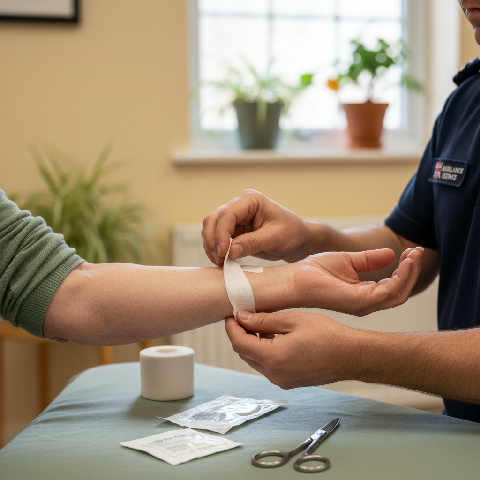
How to Become a Paramedic in the UK
Paramedics are the senior clinicians on an emergency ambulance. You assess patients at home, at work or at the roadside, decide what treatment they need, give drugs and emergency care, and choose whether they go to hospital, get help from another service or can safely stay at home. A growing number of paramedics also work in GP surgeries, urgent treatment centres, emergency departments, control rooms and air ambulances.
Paramedic is a protected title, so you can only use it once you are registered with the Health and Care Professions Council (HCPC). Every approved route is now at degree level: either a university degree in paramedic science or a degree apprenticeship with an ambulance service. This guide covers both routes, what universities and ambulance services look for, the driving licence you will need, and what paramedics earn on the NHS pay scale.
Quick facts
- Starting salary
- £31,049 - £37,796 (NHS Band 5, 2025/26)
- Mid-career salary
- £38,682 - £54,710 (NHS Band 6/7, 2025/26)
- Senior salary
- £50,000 - £65,000
- Work environment
- Ambulance, shifts including nights
- Time to entry
- 3 years
- Degree required
- Yes
- Category
- Public Sector and Emergency Services
Compare pay across careers in the UK salaries by career report. Also in: Stable careers, Career change.
What a Paramedic does
Provide emergency medical care at the scene and en route to hospital.
How to become a paramedic in the UK
Most people qualify through a three-year BSc (Hons) in Paramedic Science at a university approved by the HCPC. Around half the course is spent on placement with an ambulance service and in settings such as emergency departments, maternity units and GP practices. Universities usually ask for A levels or an equivalent such as an Access to Higher Education diploma, plus GCSE English, maths and science at grade 4 or above, and they interview against NHS values. You will also need an enhanced DBS check and occupational health clearance.
The second route is a paramedic degree apprenticeship. Ambulance services recruit apprentices, often from their own staff such as emergency care assistants and associate ambulance practitioners, and pay a salary while the university part of the training is funded by the employer. Places are limited, so many people work in a support role on the ambulances first. In England, students on the university route can apply to the NHS Learning Support Fund for a training grant of at least £5,000 a year that does not have to be paid back, on top of the usual student finance.
- Check the entry requirements of the courses you like: usually A levels or an Access to HE diploma, plus GCSE English, maths and science at grade 4 or above.
- Look at the driving licence rules early, because most ambulance services want a full manual UK licence and many ask for category C1, which licences issued since 1997 do not include.
- Get some experience of care or the public under pressure, such as healthcare assistant work, St John Ambulance volunteering or community first responder schemes.
- Apply for a BSc (Hons) Paramedic Science through UCAS, or for a paramedic degree apprenticeship when your local ambulance service advertises places.
- Prepare for a values-based interview and, at some universities, a fitness or manual handling test, then pass the DBS and occupational health checks.
- Complete your degree, including your clinical placements, and register with the HCPC so you can work under the protected title of paramedic.
- Start as a newly qualified paramedic on NHS Band 5, then move to Band 6 when you complete the newly qualified paramedic programme, usually within two years.
| Route | How long | Cost | Best for |
|---|---|---|---|
| BSc (Hons) Paramedic Science | Usually 3 years full-time | Tuition fee loan; in England, NHS Learning Support Fund grant of at least £5,000 a year | School leavers, Access to HE students and career changers who can study full-time |
| Paramedic degree apprenticeship | Usually 3-4 years | Paid by the employer; you earn a salary | Ambulance staff such as emergency care assistants and associate ambulance practitioners |
| Ambulance support role first | 1-2 years before applying | Paid | Gaining experience and an internal route onto an apprenticeship |
How most people actually get started
Most new paramedics come through the university degree, and many of them are not school leavers: Access to HE diplomas are common, and universities value life experience. The apprenticeship route suits people who need to earn while they train, but ambulance services usually offer it to their own staff first. If you are changing career, a job as an emergency care assistant, ambulance support worker or healthcare assistant lets you see the work up close and puts you in a strong position for both routes.
How long it takes
Three years on the degree route and three to four on an apprenticeship, after which you register with the HCPC and start work as a newly qualified paramedic. If you need to gain entry qualifications first, an Access to HE diploma usually adds one year.
Paramedic salary in the UK
Paramedics in the NHS are paid on the Agenda for Change scale. Newly qualified paramedics start on Band 5, which runs from £31,049 on the 2025/26 scale, and move up to Band 6, £38,682 to £46,580, once they complete the newly qualified paramedic programme. Specialist and advanced paramedics, such as critical care paramedics and paramedic practitioners, usually work at Band 7, £47,810 to £54,710, and senior clinical and management roles pay around £50,000 to £65,000. Pay rates change most years, and ambulance staff also receive extra pay for unsocial hours, plus a high cost area supplement in and around London.
Is paramedic a good career?
Paramedic work suits people who stay calm, think clearly under pressure and like talking to people from every walk of life. Demand is steady across the four UK ambulance services and in primary and urgent care, and the career has clear steps up into critical care, advanced practice, education and management. The trade-offs are shift work, a physically and emotionally demanding job and time spent waiting to hand over patients at busy hospitals.
Key skills
- Clinical judgement
- Calm under pressure
- Communication
- Stamina
Will paramedics be replaced by AI?
Low exposure. No. Emergency care in homes, streets and vehicles is about as unpredictable as work gets. AI may help with triage and dispatch, not with treating patients at the scene.
What AI already does in this job
- Call triage and dispatch support
- Patient report forms
What stays with a person
- Treating patients in uncontrolled settings
- Fast clinical decisions under pressure
- Calming patients and bystanders
One of the lowest-exposure careers in healthcare. Advanced practice routes increase pay and responsibility.
Related careers that are also hard to automate
- Paramedic Practitioner - advanced clinical practice
- Firefighter - emergency response work
- Operating Department Practitioner - hands-on clinical work in theatres
More on AI and work: check another job, jobs AI will replace, AI-proof jobs.
Our rating judges how much of the role's everyday work current AI tools can already do or draft; it measures exposure, not job losses. Occupation findings are from the Department for Education, The impact of AI on UK jobs and training (November 2023).
Paramedic FAQs
How do I become a paramedic in the UK?
Complete an HCPC-approved BSc (Hons) in Paramedic Science, usually three years, or a paramedic degree apprenticeship with an ambulance service. Once you pass, you register with the HCPC and start work as a newly qualified paramedic on NHS Band 5.
Can I become a paramedic without a degree?
Not any more. Every approved route is at degree level, but a degree apprenticeship lets you earn a salary while you study instead of paying tuition fees. Many people start in an ambulance support role and apply for an apprenticeship through their employer.
What driving licence do paramedics need?
Most ambulance services ask for a full manual UK licence, and many ask for the C1 category, which covers vehicles between 3.5 and 7.5 tonnes. Licences issued since 1997 do not include C1, so check each service's rules before you apply, as some help you add it.
How much does a paramedic earn in the UK?
Newly qualified paramedics start on NHS Band 5, from £31,049 on the 2025/26 scale, then move to Band 6, £38,682 to £46,580. Specialist and advanced paramedics usually earn £47,810 to £54,710 at Band 7, with unsocial hours pay on top.
Is there funding to train as a paramedic?
In England, students on a paramedic science degree can apply for tuition fee and maintenance loans, plus the NHS Learning Support Fund training grant of at least £5,000 a year, which you do not pay back. On a degree apprenticeship your employer pays for the training and you earn a salary.
Is Paramedic right for you?
Career Compass ranks careers from your interests and priorities and explains every suggestion, with UK routes and trade-offs. See how well Paramedic actually fits you. £19.99 once, full report included.
Comparing paramedic with other careers? A career quiz gives you a type; a proper assessment gives you reasons, routes and trade-offs.